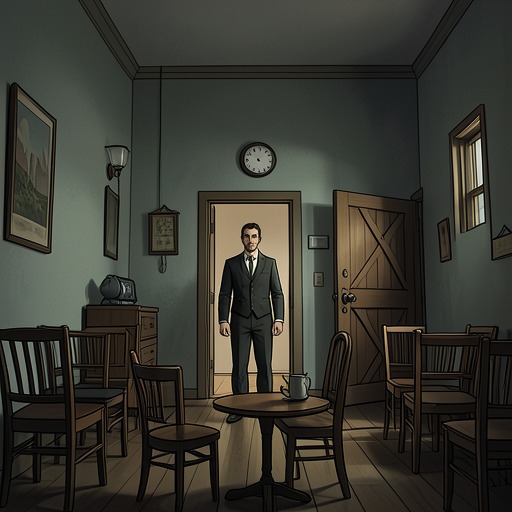
“a wedge-shaped core of darkness”
To the Lighthouse“A wedge-shaped core of darkness” is Mrs Ramsay’s image for the inward self she discovers when she is alone: hidden beneath the visible roles of family life, yet a source of freedom, depth, and rest. Its darkness is not emptiness but a private region beyond what others can know by observing her.
The private self beneath social life
After James has been carried away, Mrs Ramsay reflects that children remember what adults say and do. The responsibility of attending to others makes bedtime a relief: she can stop thinking about anybody and be by herself. Though she continues knitting and sits upright, the outward activity does not define her inward condition. The bustle of being and doing falls away, leaving an invisible self that has shed its attachments and is free for what she calls the strangest adventures.
The phrase gives this solitude a shape without making it fully visible. A wedge suggests a distinct, concentrated core, while darkness marks how inaccessible it remains to other people. Mrs Ramsay contrasts this hidden depth with the “apparitions” by which people are known to one another: the recognizable versions of themselves that rise briefly to the surface. Beneath those appearances, she imagines something spreading and unfathomably deep.
Solitude, freedom, and shared depth
The inward self does not isolate Mrs Ramsay into a fixed identity. When life sinks down for a moment, her experience seems limitless: she imagines the Indian plains and the interior of a church in Rome. These distant places enlarge the reach of solitude, which releases her from the fret and hurry associated with personality. The darkness is therefore both private and expansive, an interior state from which she can range beyond her immediate surroundings.
She also suspects that this depth belongs to others. Lily Briscoe and Augustus Carmichael, like Mrs Ramsay, have visible appearances that do not exhaust what they are. The image thus resists the assumption that a person can be completely known through familiar behavior or social identity. Each person rises into view only intermittently; an unseen life remains beneath the surface.
The lighthouse as an image of inward recognition
At this hour Mrs Ramsay looks toward the lighthouse and fixes on its “long steady stroke,” the last of the three strokes she watches. She calls it her stroke: in the act of looking, she attaches herself to one thing and can feel herself becoming what she sees. The image of the dark core therefore meets a corresponding movement outward, toward an inanimate light that seems to express and recognize her. The light’s searching appearance, like her own searching attention, offers an image of inward scrutiny rather than a simple escape from the self.
In this reflective stillness, phrases rise and change in her mind. She repeats that children do not forget, then adds that things will end and come, before saying that people are in the hands of the Lord. She immediately resents the religious statement as something she has been trapped into saying and does not mean. Looking again at the lighthouse’s third stroke, she imagines it searching her mind and heart and purifying the lie. The episode places the private self beside the pressure of inherited language: solitude lets Mrs Ramsay hear what she has said, question whether it is truly hers, and return to the image of the light as a more faithful expression of her inward state.
A momentary form of rest
When things come together, Mrs Ramsay experiences peace, rest, and a sense of eternity. The wedge-shaped darkness makes that experience possible by loosening the demands of personality rather than by revealing a stable, easily stated identity. Her knitting continues in her hands, but attention shifts between the work, the lighthouse, and the inward life those objects help her apprehend. The phrase condenses the passage’s central contrast: a person’s visible presence is only a surface appearance, while solitude opens onto a deeper self that can briefly feel both free and at rest.